Sunday, December 04, 2016

Sunday, June 19, 2016
A Study after Matisse.
This is my study based on Henri Matisse's work Nu bleu IV, 1952. The original is in Musée Matisse de Nice.
Matisse did it in paper cuttings glued onto paper with pale pencil strokes.

Matisse did it in paper cuttings glued onto paper with pale pencil strokes.

Monday, February 29, 2016
The Dog.
This a copy of Picasso's minimalist drawing The Dog. He had a favourite dachshund called Lump and put it in many of his pictures.
What is interesting here is that it's done in one continious curving line, all of it. And this is how I've done it too.

What is interesting here is that it's done in one continious curving line, all of it. And this is how I've done it too.

Friday, February 12, 2016
The Thaw.
"The Thaw" is a period in Russian Art of the Soviet Period around 1956-1966 when experimentation was allowed again and new ideas, that avant-garde movements of the early 20 Century had developed, returned to the foreground.
This photo is a tribute to those artists.
(Snow, wood, January 2016)

See another "Thaw" composition on my "Normandy Photo Journal" blog here.
Friday, January 22, 2016

Saturday, January 16, 2016
The Volga Boatmen Bird Song.

The Volga Boatmen is a famous grand canvas (131,5 × 281 cm) by Ilya Repin, painted in 1870-73.
There is realism and there is symbolism in the picture. It has been endlessly analysed and reproduced, and over the years it has been attached to another great piece of Russian cultural heritage, the Volga Boatmen song, performed by Shaliapin, the Read Army Choir and Glen Miller too.
Still, a detail or two remain unexplained.
One curious little fragment is the little bird in the bottom left corner of the painting. It is shimmering in the bright sunlight. He stands on the sandbank looking at the approaching band of barge-haulers.
The colours of the bird are strikingly similar to the sunlit central figure of the composition, 'Lar'ka' (Ларька) the young blond burlak, who is adjusting his harness irritatedly while looking ahead and at the sun.
Is there a symbolic connection between the bird and the man? What is it? Is it a representation of God? Or the elusive Blue Bird of happiness? I have my theories but was hoping to find an explanation in critical writings or memoirs — and couldn't.

And what is the bird? I've used several bird identifiers, including the RSPB site, to find out. It could be a wader but waders commonly have long legs and beaks, unlike the bird in the picture. And waders usually come in flocks. It may be a temminck (RSPB description), but it does not appear on the Volga. A common European and Russian bird that is often seen everywhere is a wagtail (picture), and they usually forage alone.
A wagtail, in Russian трясогузка (literally, tail, bottom shaker) is often associated with fickleness, or diffidence, or irresponsible behaviour. How does this apply here, if it is a wagtail, I don't know. The mystery remains.
The painting in high definition can be seen on Repin's internet gallery and on Wikipedia. His signature is lower right. Other birds, presumably gulls, are seen top right. The small bird is at lower left.

Tuesday, January 05, 2016
Christmas Composition #12 (The Gift of Life)

Alexander Anichkin
2016
CHRISTMAS COMPOSITION #12 (THE GIFT OF LIFE)
wood, enamel, egg
photo
signed and dated
Provenance: enamel plate stamped 'Made in Poland 26', from family kitchenware at Plas Uchaf, Wales, currently nr. St John's Wood (Saint-Jean-des-Bois), France.
Part XII concluding my Christmas Compositions for the 2015/2016 festive season.
Monday, January 04, 2016
Christmas Composition #11 (Adoration)

Alexander Anichkin
2016
CHRISTMAS COMPOSITION #11 (ADORATION)
wood, enamel, egg
photo
signed by author l.l.
plate stamped underneath in English 'MADE IN POLAND 26'
Provenance: enamel plate stamped 'Made in Poland', from family kitchenware at Plas Uchaf, Wales, currently nr. St John's Wood (Saint-Jean-des-Bois), Normandy.
Part XI of my Christmas Compositions for the 2015/2016 festive season.
Sunday, January 03, 2016
Christmas Composition #10 (Let's Get Together and Praise the Lord)

Alexander Anichkin
2016
CHRISTMAS COMPOSITION #10 (LET'S GET TOGETHER)
wood, enamel, tomatoes, lemon
photo
signed by author l.l.
plate stamped underneath in English 'MADE IN POLAND 26'
Provenance: enamel plate stamped 'Made in Poland', from family kitchenware at Plas Uchaf, Wales, currently nr. St John's Wood (Saint-Jean-des-Bois), Normandy.
Part X of my Christmas Compositions for the 2015/2016 festive season.
Saturday, January 02, 2016
Christmas Composition #9 (We Are Not Alone.)

Alexander Anichkin
2016
CHRISTMAS COMPOSITION #9 (WE ARE NOT ALONE)
wood, lichen, a hair
photo
signed by author l.r.
Provenance: it remains unclear if the hair belongs to the author or to his dog.
Part IX of my Christmas Compositions for the 2015/2016 festive season.
Friday, January 01, 2016
Christmas Composition #8 (Here Comes the Sun)

Alexander Anichkin
2016
CHRISTMAS COMPOSITION #8 (HERE COMES THE SUN), HAPPY NEW YEAR
wood, enamel, lemon
photo
signed by author l.l.
plate stamped underneath in English 'MADE IN POLAND 26'
Provenance: enamel plate stamped 'Made in Poland', from family kitchenware at Plas Uchaf, Wales, currently nr. St John's Wood (Saint-Jean-des-Bois), Normandy.
Part VIII of my Christmas Compositions for the 2015/2016 festive season.
Thursday, December 31, 2015
Christmas Composition #7 (Children of the Sun)

Alexander Anichkin
2015
CHRISTMAS COMPOSITION #7 (CHILDREN OF THE SUN.), NEW YEAR'S EVE
wood, enamel, tomatoes, lemon
photo
signed by author l.l.
plate stamped underneath in English and Chinese (pre-simplification characters) 'BUMPER HARVEST. MADE IN CHINA. 304P-23-22CM.'
Provenance: found amongst discarded kitchenware nr. St John's Wood (Saint-Jean-des-Bois), Normandy.
Part VII of my Christmas Compositions for the 2015/2016 festive season.
Wednesday, December 30, 2015
Christmas Composition #6. (Missing)

Alexander Anichkin
2015
CHRISTMAS COMPOSITION #6 (MISSING.)
wood, glazed clay (fine china), tomatoes on wine
photo
signed by author l.l.
plate by 'Sabichi Housewares', stamped underneath.
Provenance: nr. St John's Wood (Saint-Jean-des-Bois), Normandy, found amongst discarded garden pots and crockery.
Part VI of my Christmas Compositions for the 2015/2016 festive season.
Tuesday, December 29, 2015
Christmas Composition #5 (The Green Planet).

Part V of my Christmas Compositions for 2015/2016 season. This one is called 'The Green Planet.'
Alexander Anichkin
2015
CHRISTMAS COMPOSITION #5 (THE GREEN PLANET.)
wood, glazed clay (fine china), lemon
photo
signed by author l.l.
plate by 'Sabichi Housewares', stamped underneath.
Monday, December 28, 2015
Christmas Composition #4. (The Blue Planet.)
Part IV of my Christmas Compositions for 2015/2016.
Alexander Anichkin
2015
CHRISTMAS COMPOSITION #4 (THE BLUE PLANET.)
wood, glazed clay (crockery), lemon
photo
signed by author l.l.
plate design by an unknown author, stamped underneath 'Corona, microwave, Colombia.'

Sunday, December 27, 2015
Christmas Composition #3 (Hope).
Part III of my 'Christmas Composition' series of avant-garde installations for 2015/2016 festive season.
Alexander Anichkin
HOPE
wood, glazed clay and holly twig
signed and dated by author, l.l.

Saturday, December 26, 2015
Christmas Composition #2
Second part of my Christmas Compositions 2015.
Alexander Anichkin
THE MAJORITY AND THE MINORITY.
signed b/l.
wood, glazed clay (crockery) and carrots.

Alexander Anichkin
THE MAJORITY AND THE MINORITY.
signed b/l.
wood, glazed clay (crockery) and carrots.

Friday, December 25, 2015


Wednesday, December 16, 2015
Squinting Chekhov.
I never realised Chekhov had a squint. I've always had a soft spot for people with a squint, especially in women. 'What else did she want, that witch with a very slight squint in one eye?' (from Bulgakov's novel The Master and Margarita, tr. by Michael Glenny).
But Chekhov! The great playwright and humourist, the master of short story who is always portrayed with his trademark pince-nez on!
In this portrait of 1903, Serov, a great portraitist (he is famous for the portrait of Shaliapin among others), removes the pince-nez and tucks it inside Chekhov's waistcoat at the bottom of the picture, as though saying, there, he is not a sad narrator of declime, doom and gloom, look, he is a bubbly, fun loving man.
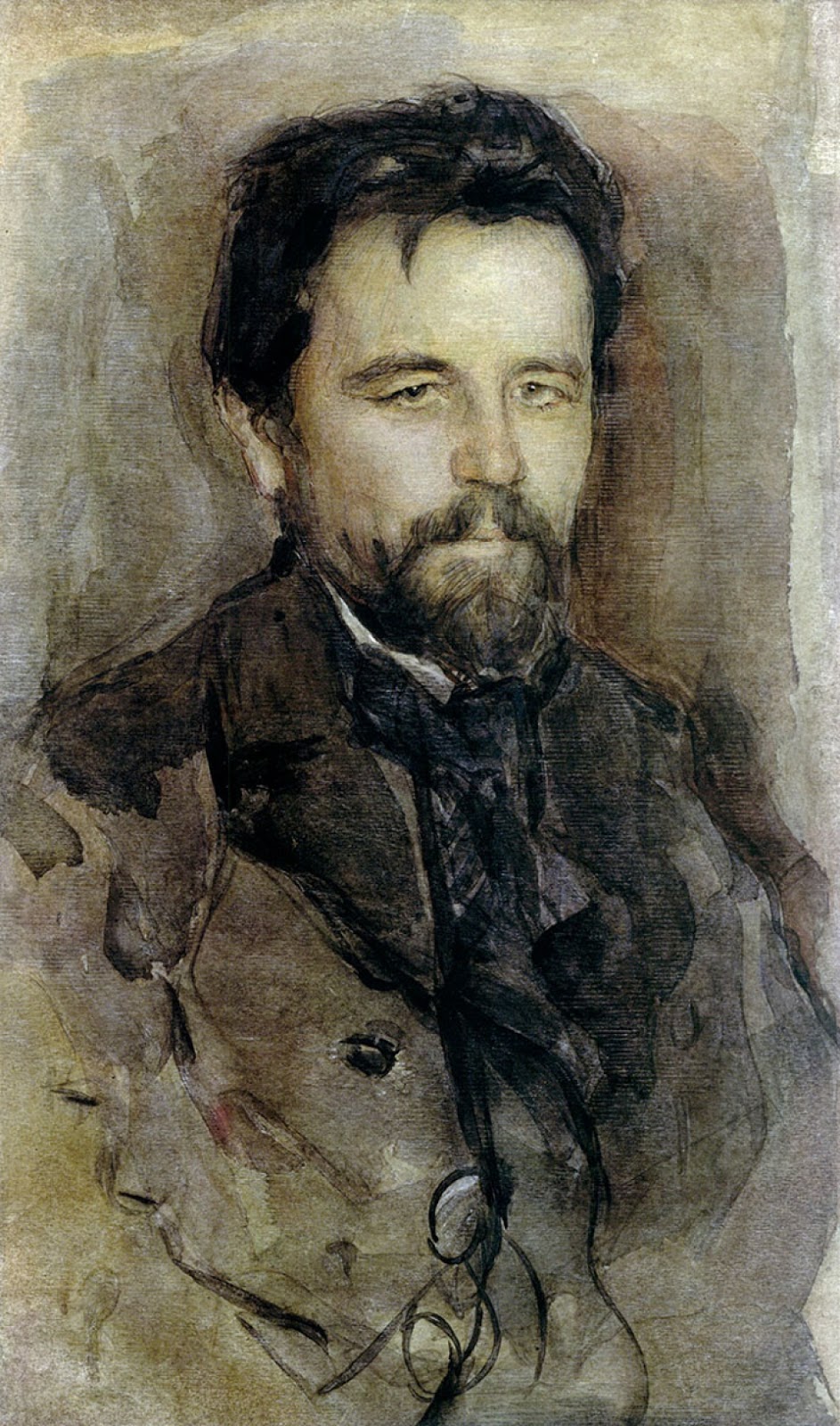
This portrait and a big gallery of Serov's works is here on Wikiart.
Tuesday, December 01, 2015
Motherhood.
I am reading 'The Russian Experiment in Art. 1863-1922' by Camilla Gray. Slanted crossing lines was one of the hallmarks, a discovery of the avant-garde.
With this photo of my cat Milka with kittens I pay tribute to that wonderful period.
(By the way, one kitten, all black with a sliver of silver white on the back of her neck, is still up for adoption. Lively character, good for witchcraft.)

Subscribe to:
Posts (Atom)
